010.25.420.03 Slewing Bearing
Selection Guide
A slewing ring (slewing bearing) is a large integrated bearing that carries axial load, radial load and tilting moment simultaneously, usually with a gear ring (internal, external or none) and mounting holes. To select one we need: axial load, radial load, tilting moment (derived from eccentricity times load), slewing speed, duty cycle and gear ring data. Because the loading is complex, we strongly recommend submitting a full load spectrum so we can check it against the bearing capacity curve before fixing the model.
Frequently Asked Questions / FAQ
Is RAYSDE 010.25.420.03 available, and what is the MOQ?
010.25.420.03 is supplied by RAYSDE through ISO 9001:2015 certified partner factories, with both stock and build-to-order options. Standard-part MOQ is tiered by bore: ≤50mm:500 pcs / 51–100mm:100 pcs / 101–300mm:20 pcs / >300mm:4 pcs; non-standard items are quoted per drawing. Send an inquiry for formal pricing and lead time.
What are the technical specifications of RAYSDE 010.25.420.03?
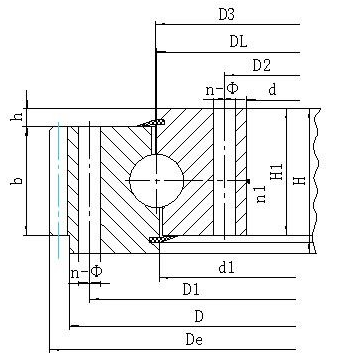
Key parameters of the 010.25.420.03 Slewing Bearing: bore d=325mm, outer D=535mm, width B=74mm. For the full dimension table, load and speed data, and CAD drawings, please contact RAYSDE.
Which industries and equipment use the 010.25.420.03 Slewing Bearing?
Fitted to excavator and crane slew drives, wind turbine yaw and pitch systems, construction machinery slewing platforms, port cranes, radar and antenna mounts, solar trackers, medical equipment arms and any machine needing low-speed, high-torque rotation.
What are the advantages of RAYSDE 010.25.420.03 versus imported brands?
As a supplier partnered with ISO 9001:2015 certified factories, RAYSDE offers 010.25.420.03 at competitive ex-works pricing with shorter lead times than comparable imported brands, plus non-standard customization and OEM support. Partner factories certified to ISO 9001:2015, with 3.1 material certificates available.
Can you provide engineering drawings and material certificates for 010.25.420.03?
Yes—CAD/DXF/PDF high-precision drawings and 3.1 material certificates (GCr15 bearing steel) for 010.25.420.03 are available on request from RAYSDE.
0102542003 What parameters do you need to select a slewing ring?
Please provide axial load Fa, radial load Fr, tilting moment M (eccentric distance times load), slewing speed and duty cycle (continuous or intermittent), gear ring type (internal, external or none) with module and tooth count, mounting hole pattern and quantity, and the operating environment (temperature, dust, corrosion). With these we can check the load against the capacity curve and propose a specific model and gear specification. If you only have an existing part number, we can also offer an interchangeable replacement from the catalogue data.
0102542003 What is the lubrication and maintenance interval for a slewing ring?
Slewing rings are normally greased before delivery; check and top up after the first run. Under normal duty, re-grease roughly every 100–200 operating hours, shortening the interval in dusty or wet conditions. Lubricate the raceway through each grease nipple while slowly slewing so the grease distributes evenly. Inspect tooth flanks regularly for wear and pitting, and stop the machine immediately if abnormal noise or tight rotation appears.