30310E/Inner Assembly Tapered Roller Bearing
Selection Guide
Tapered roller bearings carry heavy combined radial and axial load in one axial direction; axial capacity depends on the contact angle (larger-angle series carry more axial load). They must be used in pairs with correct axial clearance or preload — too much clearance causes vibration and early failure, too little raises temperature and power consumption. Verify: contact angle series, pairing arrangement (face-to-face DF / back-to-back DB / tandem DT), and whether the series is inch-size. Important: for shipments to the United States, please confirm the applicable anti-dumping duty position for this product category before ordering.
Frequently Asked Questions / FAQ
Is RAYSDE 30310E/Inner Assembly available, and what is the MOQ?
30310E/Inner Assembly is supplied by RAYSDE through ISO 9001:2015 certified partner factories, with both stock and build-to-order options. Standard-part MOQ is tiered by bore: ≤50mm:500 pcs / 51–100mm:100 pcs / 101–300mm:20 pcs / >300mm:4 pcs; non-standard items are quoted per drawing. Send an inquiry for formal pricing and lead time.
What are the technical specifications of RAYSDE 30310E/Inner Assembly?
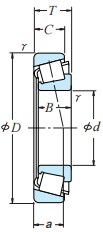
Key parameters of the 30310E/Inner Assembly Tapered Roller Bearing: bore d=50mm, outer D=50mm, width B=15mm. For the full dimension table, load and speed data, and CAD drawings, please contact RAYSDE.
Which industries and equipment use the 30310E/Inner Assembly Tapered Roller Bearing?
Used in automotive wheel hubs and differentials, construction machinery travel and slew drives, rolling mills and mining equipment, agricultural gearboxes, industrial reducers and machine tool spindles — anywhere combined radial and axial loads are high.
What are the advantages of RAYSDE 30310E/Inner Assembly versus imported brands?
As a supplier partnered with ISO 9001:2015 certified factories, RAYSDE offers 30310E/Inner Assembly at competitive ex-works pricing with shorter lead times than comparable imported brands, plus non-standard customization and OEM support. Partner factories certified to ISO 9001:2015, with 3.1 material certificates available.
Can you provide engineering drawings and material certificates for 30310E/Inner Assembly?
Yes—CAD/DXF/PDF high-precision drawings and 3.1 material certificates (GCr15 bearing steel) for 30310E/Inner Assembly are available on request from RAYSDE.
30310E- Why must tapered roller bearings be used in pairs, and how is preload set?
A single-row tapered roller bearing carries axial load in one direction only, so bearings must be paired to handle bidirectional axial load and to locate the shaft. Back-to-back (DB) gives high rigidity and good moment resistance for short shafts; face-to-face (DF) is more tolerant of misalignment and easier to assemble; tandem (DT) suits very heavy unidirectional axial load. Preload must be calculated from speed, temperature rise and load — excessive preload sharply shortens life. Send us your operating parameters and we will confirm the setting.
30310E- How is clearance on a tapered roller bearing measured and adjusted?
In practice, clearance is set by changing axial position with shims under the end cover or with an adjusting nut, and checked by measuring shaft axial float with a dial indicator. Experienced fitters also rotate the shaft by feel to confirm it turns freely without perceptible play. Running temperature rise reduces clearance, so leave margin for thermal growth. For series assembly, use a fixed torque or fixed position process to keep results consistent.